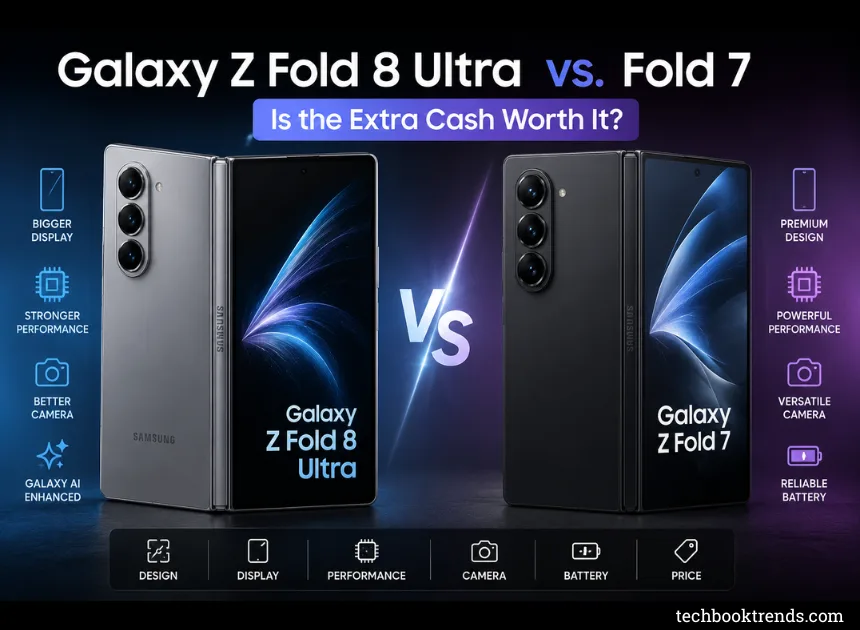
Galaxy Z Fold 8 Ultra vs. Fold 7: Is the Extra Cash Worth It?
Samsung added an “Ultra” badge to its foldable line this year. If you already have last year’s Fold 7, you’re probably asking if there’s a real reason to trade up.
The short answer? It depends almost entirely on how much you care about battery life and camera sensor sizes. Here is what actually changed between the two phones—and where the marketing hype ends.
What It Feels Like in Hand
On paper, both phones share a similar book-style design, but holding them tells a different story.
Samsung managed to shave off noticeable bulk on the Ultra. It sits flatter in a pocket, and the new titanium support frame inside makes the whole structure feel rigid without feeling heavy.
The display crease is still there—physics is physics—but the combination of the updated Flex Hinge and display layers smooths out the center trough enough that your thumb doesn’t snag on it while scrolling.
Display Improvements Outdoors
Screen size hasn’t changed dramatically, but brightness has.
-
Fold 8 Ultra: Reaches up to 3,000 nits peak brightness.
-
Fold 7: Tops out around 2,600 nits.
If you use your phone indoors mostly, you won’t notice a massive difference. But under direct sunlight—reading a PDF on a patio or taking photos outside—the Fold 8 Ultra is noticeably easier on the eyes.
Performance & AI Processing
The Ultra steps up to the Snapdragon 8 Elite Gen 5 for Galaxy. The Fold 7 runs on the original Snapdragon 8 Elite.
Both chips are overkill for daily tasks like messaging, browsing, and email. Where the Gen 5 chipset earns its keep is under sustained stress. If you run three apps at once in split-screen or edit 4K video clips, the Fold 8 Ultra stays cooler for longer before throttling down performance.
Samsung also bundled deeper Galaxy AI tools directly into the large-screen software layout—so features like Live Translate, writing assistants, and multi-window suggestions fit the 8-inch workspace much better than on standard phones.
Cameras: The Ultra Finally Gets an Upgrade
Foldables used to play second fiddle to Samsung’s standard Ultra phones when it came to optics. The Fold 8 Ultra closes some of that distance.
While both phones use a 200MP main shooter, the Ultra upgrades the ultra-wide lens to a 50MP sensor (up from the 12MP sensor on the Fold 7). Wide landscape shots have sharper edges, and night photography shows a drop in grainy noise thanks to improved AI signal processing.
Battery and Charging (The Real Reason to Buy)
Battery life was easily the weakest link on the Fold 7.
By switching to silicon-carbon battery construction, Samsung managed to fit a 5,000mAh battery inside the Ultra’s slimmer chassis. Combined with 45W wired charging (up from 25W on the Fold 7), you can actually get through a heavy workday without hunting for a charger by 4:00 PM.
Side-by-Side Specs
| Feature | Galaxy Z Fold 7 | Galaxy Z Fold 8 Ultra |
| Processor | Snapdragon 8 Elite | Snapdragon 8 Elite Gen 5 |
| Peak Brightness | ~2,600 nits | 3,000 nits |
| Display Crease | Visible | Reduced / Flatter |
| Battery Capacity | 4,400 mAh | 5,000 mAh (Silicon-Carbon) |
| Wired Charging | 25W | 45W |
| Main Camera | 200MP | 200MP (Upgraded Processing) |
| Ultra-Wide Camera | 12MP | 50MP |
| AI Features | Galaxy AI | Galaxy AI Suite |
| Build & Hinge | Armor Aluminum | Titanium-Reinforced Flex Hinge |
Who Should Upgrade?
Get the Fold 8 Ultra if:
-
You are upgrading from a Fold 5, Fold 4, or older device.
-
You use your foldable heavily for work and need all-day battery life and faster charging.
-
You take lots of outdoor photos or struggle to see your screen in bright sunlight.
Skip it if:
-
You already own the Fold 7. The performance boost, screen, and build tweaks are nice refinements, but they aren’t fundamental reasons enough to spend money on a replacement just 12 months later. The Fold 7 remains a fast, exceptionally capable phone that will receive software updates for years to come.