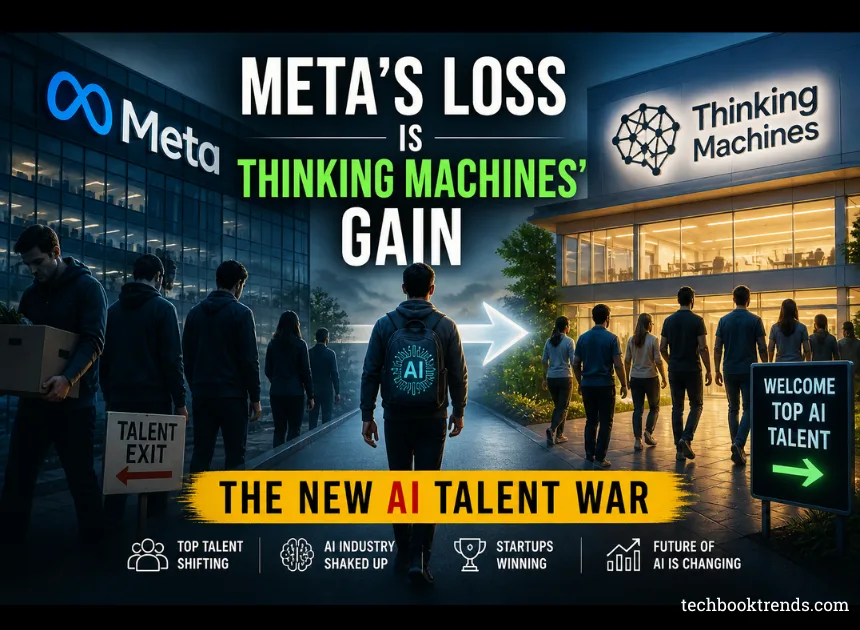
Meta’s Loss is Thinking Machines’ Gain: The New AI Talent War
Now, Meta AI is not just a buzzword; instead, it has grown up to be more than models and data; now it’s about people as well. These days, a headline is capturing attention: Meta’s Loss is Thinking Machines.
It might sound like a reshuffle. But it is more than that. Let’s dig a little bit into it and reveal the truth behind the headline.
The Shift Behind the Headline
Meta’s platform is one of the most aggressive players in the world of AI. From open-source breakthroughs like LLaMA to the metaverse. It costs a lot of money.
Having all of the scaling and resources, Meta thought it would not face any challenge. But it had the problem of retaining and attracting top-tier researchers.
On the other side stands The Machines Lab – an AI venture. Led by Mira Maruti, formerly of OpenAI. The company is attracting some of the brightest minds.
Why is Talent More Than Ever?
When an employee leaves a traditional industry, it doesn’t usually affect the overall power structure. But AI is different.
In AI, an individual top researcher can:
- Create new architecture models that will change how we look at models
- Improve the efficiency of training by huge amounts
- Change the way products are developed for years to come
Because of this, AI resembles a Formula racing team more than a factory because a small number of people determine who wins.
When talent moves into AI:
- That’s more than just hiring someone.
- There is an element of strategy associated with that decision.
Why Start-ups Are Winning This Round
It will come to mind how they can compete with tech giants like Meta. These are the startup’s advantages:
- Speed over structure
- Clear vision
- Ownership and impact
- Culture and Curiosity
Is Meta Really Losing?
Not entirely. As Meta still has the following:
- Massive compute infrastructure
- World-class research teams
- Strong open-source influence
But the problem doesn’t lie in having infrastructure and research teams and staying strong. The win is while staying ahead.
The Bigger Picture
Broadly, this is the shift reflected across the AI ecosystem:
- Talent’s mobility
- Powerful Start-ups
- Leadership and vision are what make the difference.
Therefore, the rise of Thinking Machines shows that new players can emerge quickly if they attract the brightest minds.
Conclusion
“Meta’s loss in Thinking Machines gain” is not a phrase anymore; it is a warning.
Additionally, it is telling the following:
- The AI race is growing rapidly.
- Game protocols are changing.
- And the winner is not going to be the strongest with the most resources, but it will be someone who can bring the smartest people with a clear vision.
Frequently Asked Questions
Ans. “The loss of talent by Meta and other large tech organisations represents a gain by small startup organisations such as Thinking Machines, as they now have many of the best AI researchers,” says Roy Peabody, co-founder of Thinking Machines. “The research and development capabilities and innovation potential connected to the former Meta employees will be powerful and will build the success of their organizations.”
Ans. In AI, compared to traditional industries, a small number of highly talented researchers can create groundbreaking models to solve complex problems, improve process efficiencies, and build the future of technology.
Ans. Thinking Machines, an AI-focused start-up, is well-positioned for success in attracting the best AI researchers with experienced leadership from leading AI organizations. The company has a strong vision, focused on creating innovative products and services.
Ans. Start-ups tend to have less bureaucratic process, which includes fewer levels of decision-making in leadership, clearer and more concise business visions, more ownership of their jobs or work, and a more entrepreneurial culture. As such, for researchers or individuals who want an opportunity to positively impact the organization they work for, the environment within start-up companies is more appealing compared to large technology companies that have structured and rigid corporate environments.
Ans. Not necessarily, it still has a large amount of infrastructure, a few very strong research teams, and a large influence in the open-source AI community; however, retaining and attracting the best talent is becoming increasingly difficult.