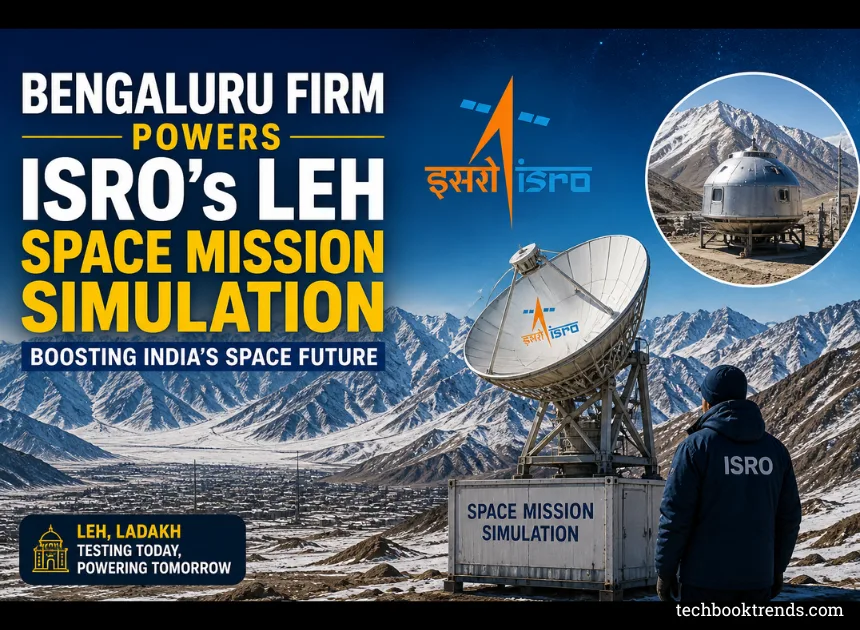
Bengaluru Firm Powers ISRO’s Leh Space Mission Simulation
A recent collaboration between a Bengaluru-based organisation which supports ISRO’s Leh Space Mission, Simulation in Leh. Moreover, it represents a huge milestone for India’s human spaceflight ambitions. It also demonstrates the role that the private sector will play in the country’s space ecosystem.
What Is the Mission About?
The simulation component is part of ISRO’s preparation for future human space missions. In particular, it’s the upcoming Gaganyaan mission. This simulation was termed Mission MITRA (Mapping of Interoperable Traits and Response Assessment).
Additionally, the high altitude of Leh is noted. Reason: to facilitate research on how humans function in simulated space conditions. As a result, such simulations are referred to as analogue missions. They essentially replicate space-like conditions on Earth.
Why Leh Was Chosen
Leh is situated in the region of Ladakh. Additionally, possesses many characteristics of a space-like environment. These include:
- Lower levels of oxygen (creating suitable conditions for conducting research),
- Extreme temperature conditions,
- Isolation from civilisation and,
- Located in a mountainous landscape.
Therefore, these conditions make Leh an ideal location for simulating the surface of the Moon or Mars.
Role of the Bengaluru Firm
Protoplanet, a Bengaluru-based start-up. It is pivotal throughout the duration of this mission. The company designed and built key infrastructure, including
- Compact living modules,
- Remote field camps, and
- The mission control system.
ISRO’s focus was primarily on research and astronaut studies. Together, both companies created the controlled conditions to simulate an actual space mission.
What Was Tested
The mission’s primary focus was on human factors. Specifically, the research studied :
- Stress levels,
- Decision making, and
- Teamwork has been developed by the organisation.
Tracking of physical health using wearable sensors and monitoring cognitive performance throughout the mission.
In order to more closely simulate an actual mission, participants consumed freeze-dried foods that closely mimic what astronauts eat.
Why This Matters
There are multiple reasons why this is an important mission. First, it demonstrates that space is not all about technology. The space mission requires human astronauts who need to sustain their lives under extreme space conditions. The mission directly supports the Gaganyaan mission through its training programs and improved safety measures. The mission helps India prepare for future extended space missions, which will include upcoming lunar and Mars expeditions.
Rise of Private Space Participation
The private space industry has shown a substantial increase in its development because ISRO and private companies now work together more effectively than before. Protoplanet’s recent partnership with our organisation demonstrates how public and private entities can work together through this partnership model. This model is already adopted by numerous global space programs. Thus, enabling collaborative business models that will accelerate innovation and reduce costs.
Final Thoughts
The Leh simulation is much more than just an experiment. It represents the next evolutionary step. Also, reflecting how ISRO has progressed with its space exploration efforts. As ISRO continues to improve, more entrepreneurs and emerging businesses want to develop forward-thinking, innovative technologies for both India and the world.
These partnerships allow ISRO to establish its foundation for continued growth. Whether in completing human space flight missions, or while preparing for future human space flight missions, outside the low Earth orbit (LEO).
FAQ’s
About Experiment
Mission MITRA’s purpose is to replicate an outer space mission, but on Earth. It includes a simulated environment, where astronauts conduct research on human behaviour, and overall health and performance. When they are exposed to an environment similar to outer space.
Hypoxia (low level of oxygen), temperature and isolation represent physical conditions characteristic of lunar and martian environments. Therefore, making Leh an ideal location for analogue missions.
An analogue mission is conducted on Earth. Basically, it is designed to replicate conditions encountered in space (via the use of technology) in order to ascertain the adaptability of human endurance and capabilities prior to attempting actual outer space travel.
Conducting an analogue mission will increase the level of safety training, enhance overall safety, and provide a database. Thereby, facilitating outcomes necessary in support of Gaganyaan.
Protoplanet provided key infrastructure such as Crew Living Modules, Field Camps, and Mission Control Systems designed to replicate conditions experienced by astronauts during real outer space missions.
The simulation was conducted in order to determine
1. levels of stress,
2. decision-making skills,
3. teamwork,
4. physical health, and
5. cognitive performance using wearable sensors.
Participants consume freeze-dried food in order to copy the conditions found in space.
Impact of Experiment
People’s ability to cope with long-duration missions away from home. Their mental well-being. Team-building will be a critical factor in determining whether or not a space mission will succeed. Especially during periods of long-term isolation and high stress.
People’s ability to cope with long-duration missions, their mental health, and team-building are critical factors.
Considerably more of the same kind of experimental missions will be conducted by India.
These experiments will provide scientists with critical insight into the physiological and psychological adaptations of humans in extreme environments.
Technology tested in the experiment includes: habitat modules, life-support systems, wearable health monitors, and communications equipment.