How Hearables Are Made: Inside Modern Wireless Earbuds
Hearables (especially true wireless earbuds) have become an essential part of everyday technology. However, most users only notice the outer design and features. At the same time, the real complexity lies inside.
In fact, these small devices combine audio engineering, wireless communication, and smart processing into a compact form.
Core Components Inside Hearables
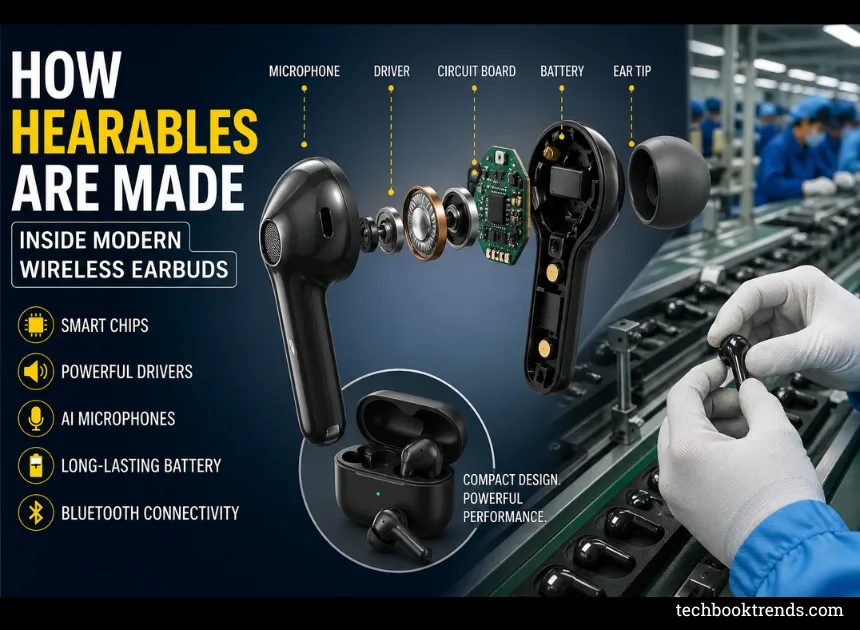
Speaker Driver (Sound Engine)
The speaker driver is the most important component. It converts electrical signals into audio waves that you hear
Most earbuds use dynamic drivers. There are some premium earbuds with balanced armature drivers, which deliver better sound quality.
Microphones
As I mentioned above, microphones are used for voice calls, ANC (active noise cancellation), and awareness of your surroundings. In fact, many higher-end earbuds include several microphones found inside each one. Results in improving call quality and noise cancellation.
Battery
It comes with a tiny, rechargeable Lithium-Ion battery. It charges the earbud for a number of hours. Also, it is replenished through the charging case.
As a result, manufacturers concentrate on obtaining both a balance of size and efficiency in order to keep the overall size small.
Bluetooth Chip
The Bluetooth chip that connects each earbud to the Bluetooth device. Examples are smartphones and computers.
It also helps to ensure that you have a stable connection with low latency by working with many different audio codecs.
Processor
A processor is the brain of the earbud. It controls the way the earbuds process audio, ANC, and touch controls, as well as the overall performance of the earbuds.
It also has a major role to play in the earbud’s battery (power) efficiency and how the different features work together.
Sensors
Hearable devices have various sensors for improving user experience. Common sensors include touch points, proximity detection to automatically play or pause sound, and motion sensors to track the user’s motion for additional features.
Because of the sensors built into the earbud, the user will have an easier time seamlessly interacting with the earbud.
Antenna
There is a small antenna inside the earbud to transmit Bluetooth signals.
The engineers place the antennas to ensure that a stable connection is maintained. Also, to eliminate as much interference as possible.
Active Noise Cancellation Hardware
Earbuds with ANC use both hardware and software to cancel out noise from the environment by using external microphones to capture the sound, while the processor creates an opposite sound wave to eliminate the external noise.
The end result is a real-time reduction of unwanted noise.
Outer Shell and Acoustic Design
The outer casing not only provides protection but also helps with airflow and enhances audio quality. Also, it ensures that the earbuds fit comfortably.
In addition, engineers very carefully position all of the internal components in the compact design.
How Hearables Work Together
Modern-day hearables are a collection of technologies in a very small package. Each hearable has integrated audio systems, wireless connectivity, and intelligent processing (i.e., “smart technology”) in one package.
As a result, hearables not only play audio; they are becoming smarter, wearable technology.
Why Hearables Are Advanced Today
Modern-day hearables are a collection of technologies in a very small package. Each hearable has an integrated audio system, wireless connectivity, and intelligent processing (i.e., “smart technology”) in one package.
As a result, hearables not only play audio; they are becoming smarter, wearable technology.
Conclusion
From the outside, hearables appear simple. However, all of the internal components are very complicated. Each component works together to provide seamless audio, connectivity, and smart functions.
So, understanding how hearables work helps you understand how amazing the user experience is with modern-day earbuds.