
How To Use Drones for Crop Spraying (No Fancy Talk)
If you had told farmers ten years ago that spraying crops could be done by a flying machine, most would’ve laughed and gone back to their fields. Spraying meant walking for hours with a heavy tank on your back or driving a tractor through crops and hoping nothing breaks.
But things change. Slowly at first, then all at once.
Today, drones are quietly becoming part of agriculture — especially when it comes to spraying. Not because they’re flashy, but because they make life easier.
So let’s talk honestly about how to use drones for crop spraying, without buzzwords or complicated explanations.
First Things First: What Does a Spraying Drone Actually Do?
At its core, a spraying drone is just a tool.
A smart one — but still a tool.
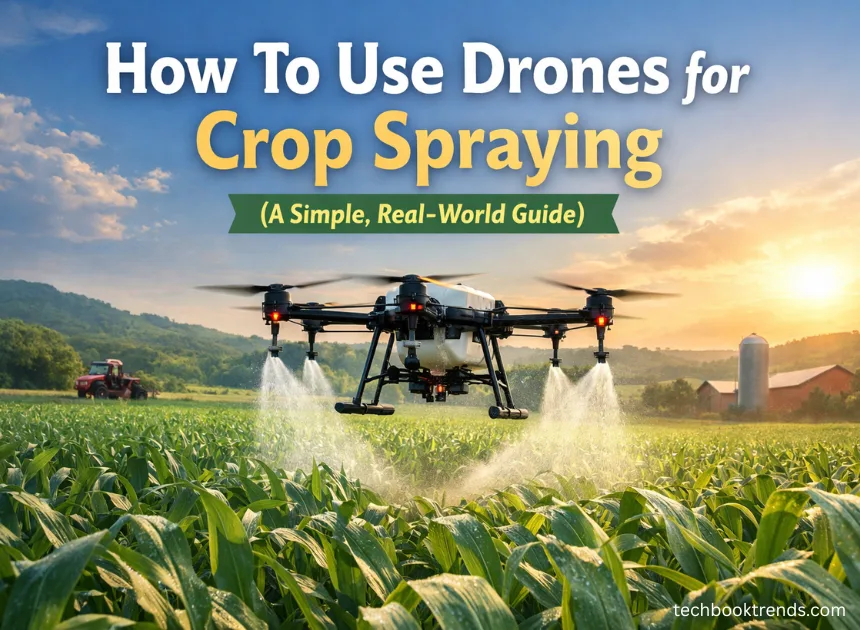
It carries a small tank filled with pesticide, fertilizer, or nutrient solution. Instead of you walking through the field, the drone flies over the crops and sprays evenly from above.
You don’t need to “fly” it like a camera drone. Most agricultural drones work on preset routes. You mark the field area, press start, and the drone handles the rest.
That’s it. No drama.
Step 1: Preparing the Field (Yes, This Still Matters)
Before any drone goes up, the field needs a quick check.
You don’t need to measure every inch, but you should:
-
Know the boundaries of your land
-
Remove tall obstacles like wires, poles, or unexpected trees
-
Avoid spraying on very windy days
Drones are precise, but wind can push spray away. Farmers who ignore this usually regret it.
Step 2: Mixing and Loading the Spray
This part is familiar — just lighter.
The chemical or fertilizer is mixed the same way you’d do it for manual spraying, but the quantity is usually less. Drones don’t waste spray, so overdosing isn’t needed.
The mixture is poured into the drone’s tank. Most tanks are small, so large fields are sprayed in multiple rounds. The drone returns, gets refilled, and goes back up.
It sounds slow, but it’s still faster than walking.
Step 3: Setting the Spray Path
Here’s where drones feel “modern”.
Using a controller or mobile screen, the operator marks the field area. The drone software creates straight, clean paths — no overlapping, no missed spots.
This is one of the biggest reasons farmers like drones. The coverage feels neat. Crops get sprayed evenly, which is hard to achieve by hand.
Step 4: Letting the Drone Do the Work
Once everything is set, the drone takes off.
It flies low, sprays close to the plants, and follows the planned route. When the battery or tank runs low, it comes back automatically.
You’re not chasing it.
>You’re not breathing chemicals.
>You’re watching from a safe distance.
For many farmers, this moment alone makes drone spraying worth it.
Step 5: After Spraying – What to Check
After the job is done, it’s good practice to:
-
Walk a small section of the field
-
Check leaf coverage
-
Make sure no area was skipped
Most of the time, results are consistent. If something looks off, settings can be adjusted next time.
Like any tool, there’s a learning curve — but it’s short.
Do You Need to Buy a Drone to Use One?
No. And this is important.
Many farmers don’t own drones at all. They use drone spraying services. A trained operator comes, sprays the field, and charges per acre.
This avoids:
-
High upfront cost
-
Maintenance worries
-
Legal and training requirements
Buying a drone makes sense only if you spray frequently or manage large land areas.
Is Drone Crop Spraying Safe?
When used properly — yes.
In fact, it’s often safer than manual spraying because:
-
You’re not exposed directly to chemicals
-
There’s less chance of overuse
-
Spraying is controlled and targeted
That said, rules and permissions matter. Always follow local guidelines.
So, Is This the “Future” of Farming?
It already feels like the present.
Drones won’t replace everything. Farmers still need knowledge, timing, and judgment. But as a spraying tool, drones solve real problems — fatigue, time, health, and efficiency.
And farmers don’t adopt things that don’t work.
Final Thought
Learning how to use drones for crop spraying isn’t about becoming “high-tech.”
It’s about choosing a smarter way to do a tough job.
If it saves your back, your time, and your health — that’s technology worth using.
Hi my loved one! I want to say that this post is amazing, great written and come with almost all significant infos. I¦d like to see more posts like this .