
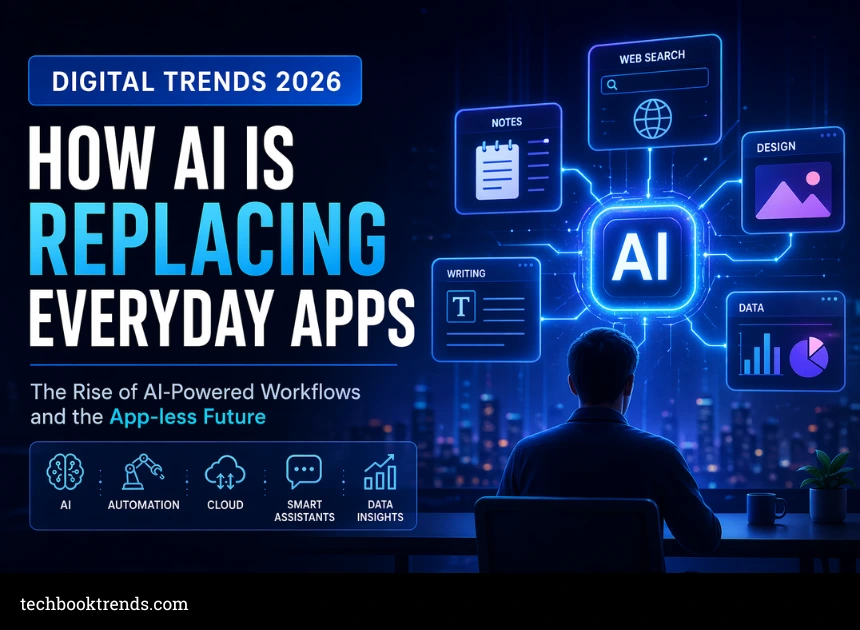
Digital Trends 2026: How AI is Quietly Replacing Everyday Apps
What are Digital Trends?
It is defined as the identification of new techniques and trends that use the digital ecosystem and the internet to carry out marketing promotions using new techniques and formats.
Fragmented Digital Experience
Most people find having to open so many applications on their devices frustrating. There are instances when you might :
- Open a note-taking application,
- Use your browser for a Web search,
- Create and edit some copied content in an external tool.
As a result, this constant switching breaks focus and reduces productivity.
AI-Powered Workflows
However, an increasing number of consumers are looking for other ways to do this than simply by using traditional applications. As they have begun to use artificial intelligence (AI) tools such as
- ChatGPT,
- Claude, and
- Gemini.
Therefore, they are directly helping in digital trends. Therefore, you could create notes, edit them, do an Internet search, and even design graphics all at one go by using AI technology.
As a result, you don’t need to go to different applications. You can do everything at once.
Multiple Tasks to One Dialogue Experience
All of this supports a more significant trend of how consumers want to get results. Not how many digital applications they must use. AI users are combining multiple tasks into one dialogue experience. AI helps users save a significant amount of time by reducing the number of required actions to produce these outputs. For example,
- if you were trying to find the best possible image using Canva
- or get the correct answer from Perplexity AI,
You no longer have to drop into multiple web applications.
Ease of Interaction
With continued advancement, the greatest development will not be the development of better applications but rather the obsolescence of them. It is possible that companies will develop technologies that create seamless integration of digital trends and allow ease of interaction between devices and programs.
Conclusion
Finally, as an interface to technology and content is increasingly dominated by Artificial Intelligence (AI), the movement could be considered an “app-less future,” where conventional applications will continue to disappear from view.
Frequently Asked Questions
Q. What are digital trends in layman’s terms?
Ans: Digital trends are new methods of using technology and the Internet to assist in our work and the way that we communicate with each other and access information. For example, artificial intelligence (AI) tools, automation, and integrated digital experiences.
Q. Why is the current digital experience considered to be fragmented?
Ans: Because most users are switching between multiple apps to complete tasks, such as note taking, searching, and editing, this creates an interruption of focus, which ultimately results in lower productivity levels.
Q. How are AI tools changing our digital workflows?
Ans: For example, ChatGPT, Claude, and Gemini allow users to perform multiple tasks, such as writing, researching, and designing, within one platform, resulting in a more efficient and quicker workflow.
Q. What does “dialogue-based experience” mean with regard to AI?
Ans: This allows a person to complete multiple tasks through the use of a single conversation with an AI as opposed to using many different applications or software programs to complete a single task. The user simply asks the AI and the AI will assist in completing the task by searching, creating content, etc.
Q. Will traditional applications be removed completely?
Ans: They will likely not be completely removed; however, the need for them may significantly decrease as artificial intelligence becomes more efficient, allowing for many tasks to be done within unified platforms leading to an “App-less” or very minimal app future.
One thought on “Digital Trends 2026: How AI is Quietly Replacing Everyday Apps”