
Why Robot Navigation Is the Backbone of AI Robotics
Without a direction, the robots would be blind, which is why Robot Navigation makes all intelligent machines run today. It allows robots to be aware of their environment and move with intent. Even sophisticated AI systems will not be able to communicate with the physical world without the assistance of navigation. Hence, it is the main pillar of AI robotics.
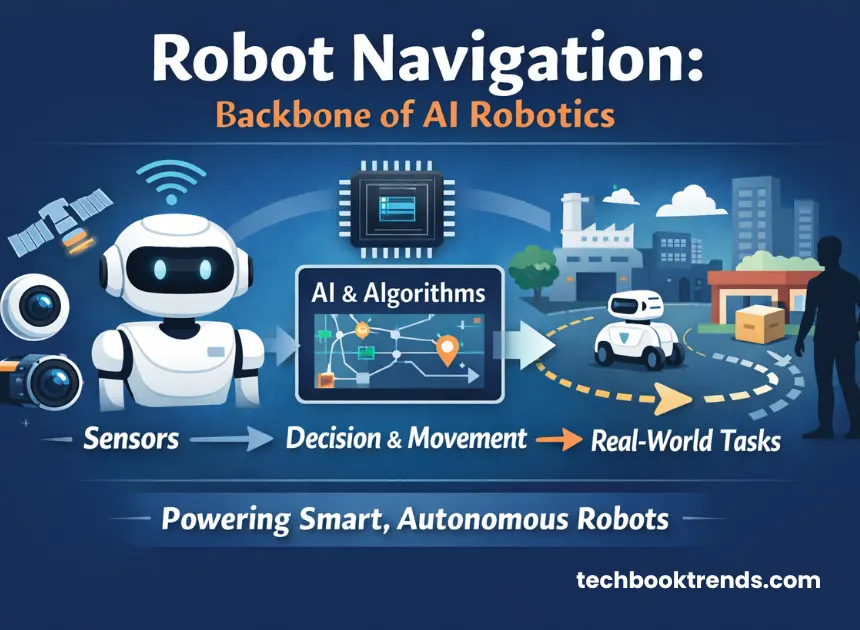
Sensors, algorithms, and real-time data processing come together in robot navigation. These aspects help robots identify hazards and design safe routes. An example is the use of cameras, LiDAR, and GPS to direct robots in tricky conditions. Consequently, machines will be able to work without much human intervention.
Besides, navigation has a direct impact on decision-making by robots. Artificial intelligence models are used to select the most appropriate course of action. As a result, robots learn very quickly to new situations around them. This capability enhances productivity within sectors such as health care, supply chain, and production.
Also, robot navigation improves the user experience and safety. The smart robots are able to navigate well and react to human beings. Delivery robots use accurate navigation to reach destinations precisely and reliably. Therefore, navigation creates trust between humans and machines.
Nonetheless, issues remain in the navigation of robots. Change and uncertain challenges may diminish precision. Engineers are still working on coming up with more advanced algorithms to address these problems. However, in the meantime, machine learning enhances the performance of the navigation as time goes by.
Finally, intelligent automation is driven by robot navigation. It is a combination of perception, decision-making, and movement into one system. With the changing technology, the navigation would be further accurate and adaptive. Thus, it still forms the support of AI robotics innovation.
Frequently Asked Questions (FAQs)
1. What is Robot Navigation in Artificial Intelligence (AI) Robotics?
Ans. In AI Robotics, Robot Navigation refers to the capability of a robot to determine the location of its physical position, analyse its physical surroundings, and move towards its destination while avoiding any obstacles.
2. What are the Core Components of Robot Navigation?
Ans. The Core Components of Robot Navigation include, but are not limited to:
(a) Knowing the Robot’s Location (Localization);
(b) Having a Description of the Robot’s Environment (Mapping);
(c) Developing a Plan to Get from Point A to Point B (Path Planning), and
(d) Executing the Movement along that Path (Motion Control).
3. What is Simultaneous Localization and Mapping (SLAM) in Robotics?
Ans. SLAM in Robotics is a process for building a description of an unknown environment, along with information about the Robot’s location within that same environment.
4. How does AI Improve Robot Navigation?
Ans. AI gives robots the ability to learn from past experience, adjust to new environments, recognize objects within an environment in real-time, and make decisions with regards to their movement rather than simply following a predetermined path.
5. What Types of Sensors are Used in Robot Navigation?
Ans. Robots use a variety of sensors to navigate and gather information about their environment, including cameras, Lidar, GPS, and IMUs.
6. What is Path Planning in Robotics?
Ans. Path Planning is the process of determining the most efficient and safe way for a robot to travel from one point to another while avoiding obstacles along the way.
7. What are Some of the Potential Obstacles to Successful Robot Navigation?
Ans. Some of the most significant obstacles to successful Robot Navigation include:
(1) the dynamic nature of environmental changes,
(2) sensors experiencing errors,
(3) terrain that the robot cannot map or understand what is present, and
(4) ensuring that the robot’s Localization and Mapping is still accurate after having travelled some distance beyond its original mapping.



5 thoughts on “Why Robot Navigation Is the Backbone of AI Robotics”