AI Agents Are Quietly Taking Over Work in 2026
Everyone’s talking about “AI agents” right now. Conferences, boardrooms, even random group chats — the phrase is everywhere. And honestly, it’s earned the attention. A few years back, the big AI story was chatbots: you asked a question, got an answer, done. 2026 feels different. This is the year AI stopped just talking and started actually doing.
So what changed?
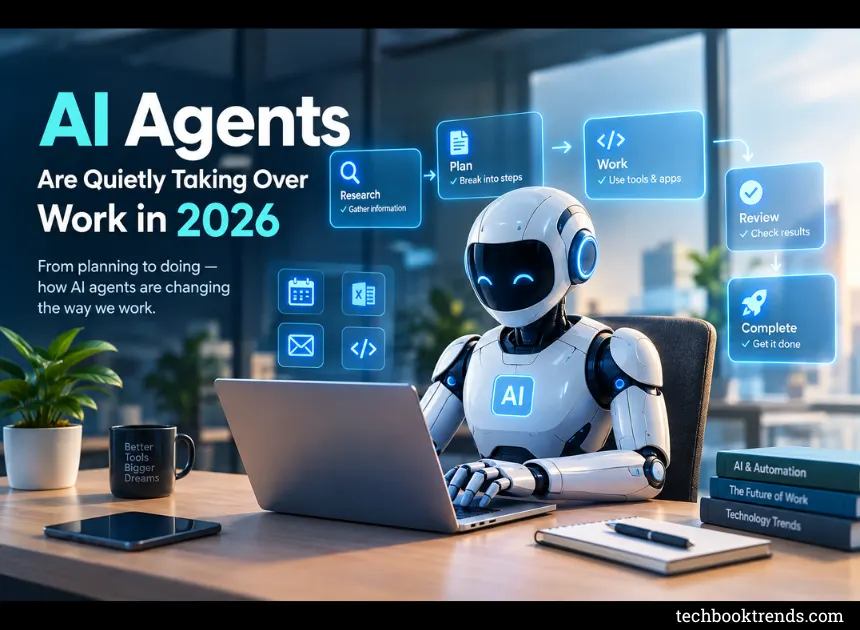
It’s a small shift on paper but a big one in practice. Old-school AI tools sat there waiting for you to type something. An agent doesn’t wait around like that — it can take a goal, break it into steps, open up your calendar or a spreadsheet or a code editor, work through the task, double-check itself, and keep going until it’s actually finished.
Not a smart assistant so much as a junior employee who doesn’t need much supervision.
Here’s the interesting part, though: a lot of companies are still testing the waters rather than diving in.
Plenty are experimenting with agents, but far fewer trust them to run completely on their own. That hesitation says a lot — the excitement is real, but so is the caution.
Why this wave feels sturdier than past AI hype
A couple of things stand out this time around.
First, businesses aren’t building one giant do-everything AI anymore. They’re setting up small crews of specialized agents that pass work back and forth — one drafts something, another reviews it, a third one ships it.
Second, a lot of this processing is moving off the cloud and onto the device itself. New AI-focused laptops and dedicated chips mean agents can run locally, which means quicker responses and less of your data floating around someone else’s server.
And third — maybe most importantly — companies are pouring money into oversight. More autonomy means more room for something to go wrong, so 2026 has also turned into the year of guardrails: monitoring tools, audit trails, kill switches, all the stuff meant to keep an agent from quietly making a mess of things.
It’s not just an enterprise thing
You don’t have to work at some big tech company to notice this. Regular apps are getting quietly “agentic” too. Your inbox might start drafting replies on its own. A budgeting app might go negotiate your internet bill down without you asking twice. Tell your browser what you want, and it might just… go buy it.
Good news or bad news?
Kind of both, if we’re being honest. People using these tools are saving real time on the boring, repetitive stuff. But there are still open questions nobody’s fully answered — what happens when an agent screws up something expensive, who’s responsible for that, and how much access should these things really have to your data? For now, the safest move (and the one most companies are actually taking) is to let agents help, but keep a person checking the work.
Where this leaves us
AI agents aren’t a buzzword anymore — they’re becoming part of the everyday tech stack, whether people notice it or not. If you’re a developer, run a small business, or just like keeping an eye on where things are headed, this is worth watching closely for the rest of the year. It doesn’t look like it’s slowing down.
Would you actually hand off part of your workday to an AI agent? Curious what people think — drop a comment below.