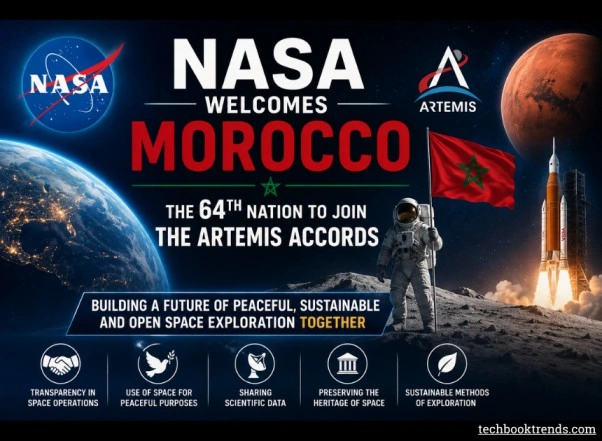
NASA Welcomes Morocco – The 64th Nation To Join The Artemis Accords
Morocco has officially become the latest signatory to the Artemis Accords through NASA, making it the 64th signatory nation. It is an ongoing endeavour that demonstrates international collaboration.
By welcoming Morocco, NASA recognised Morocco’s presence in the global space community. The joining of Morocco as an Artemis signatory further bolsters the international space coalition’s strength. Additionally, it contributes toward continued global peace and collaboration.
What do the Artemis Accords Really Mean?
The Artemis Accords specify a series of guidelines for countries to create environments for their peaceful exploration.
Morocco becomes a Member of the Global Space Coalition. Additionally, the use of space, including trips to the moon and Mars.
The accords, which were created by NASA, promote the following:
- Transparency in space operations
- Use of space for peaceful purposes
- Sharing scientific data
- Preserving the heritage of space
- Sustainable methods of exploration
Morocco Joins the Global Space Coalition
With its becoming an Artemis Accords member, Morocco now joins with an increasing number of partner nations in paving the future of space exploration. Morocco’s decision to execute the accords was predicated on its prior investment in science, technology and innovation.
By acceding to the Artemis Accords, Morocco will now be able to do the following:
- Improve its capabilities for space research and satellite technology
- Increase opportunities for international partnerships
- Create conditions to support future development in Earth’s climate monitoring.
Morocco is poised to play a key role in the African space community and will promote collective engagement within Africa for participating in global efforts relating to space.
Looking at Developing International Partnerships
The creation of an inclusive international coalition made up of 64 Artemis Accords signatories is part of NASA’s long-term plan to develop additional countries for their Artemis mission and expand the number of Artemis Accords signatories. The continued addition of new signatories to the Artemis Accords will provide international legitimacy to the Artemis Accords and serve to enhance the ability of all humanity to explore outer space.
Nations that join the accords commit to:
- Collaborative and transparent relationships between nations,
- Responsible use of space.
Also, nations must avoid creating harmful interference in space activities and ensure their actions do not harm other countries, forming the foundation for international cooperation.
Vision of Tomorrow: Artemis Program
Historically, the Artemis Program will help establish a substantial long-term return of humans to the Moon, with an aim to provide a long-term human presence in the neighbourhood of the Moon.
Key components of the Artemis Program are:
- The first woman will land on the Moon, and a subsequent man will land there.
- A long-term lunar settlement will be established.
- Future preparations for missions to Mars will take place.
The involvement of Morocco could contribute to developing scientific research, sharing data on human activity in space, and advancing technology as part of this endeavour.
Why This Matters
Morocco’s signing of the Artemis Accords signifies a shift away from traditional forms of diplomatic relations with the United States towards cooperation with other nations regarding both human activity in outer space and future collaborative efforts related to space exploration.
Implications:
- Increased participation by African countries will lead to more African countries being involved in various space mission operations.
- As new economies continue to support the development of space technologies, many more countries will invest in space and the exploration of outer space.
- By maintaining a commitment to the continued cooperation and collaboration of international partners in the same spirit of peace and responsibility, international partners will have the opportunity to work together to peacefully utilise and explore the universe.
As countries continue to rely on outer space for things such as telecommunications, climate monitoring, scientific research and many other aspects of everyday life, collaboration and cooperation are critical to the success of future international missions to outer Space.
Moving Forward
As the United States continues to add new signatories to the Artemis Accords, it is becoming increasingly clear that the future of outer space exploration will be based on international collaboration as opposed to unilateral actions by individual nations. The continued addition of new Artemis treaty signatory nations is indicative of an ever-increasing understanding of this concept throughout the international community:
Space is not solely the domain of a select number of nations, but rather a global opportunity, and will require global responsibility.
Final Thoughts
The signing of the Artemis Accords by NASA and Morocco continues to raise new possibilities.
Furthermore, as more countries sign the Artemis Accords, they strengthen global collaboration in space travel and move the world closer to achieving peaceful, sustainable, and open space exploration.
As a result, Morocco’s participation will likely serve as inspiration for many other nations to join the initiative.