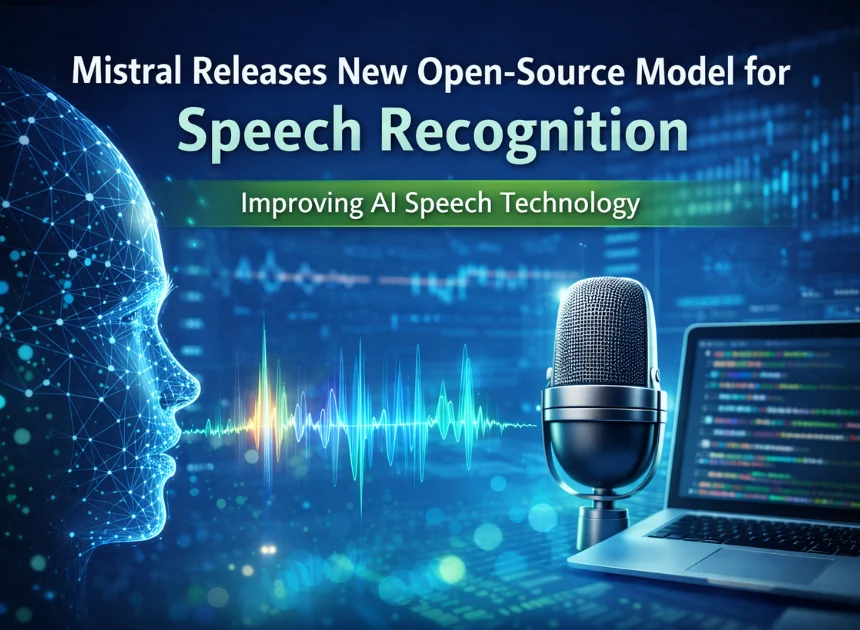
Mistral Releases New Open-Source Model for Speech Recognition
With the introduction of an open-source speech recognition model, Mistral has expanded its offerings within the AI realm to include not only textual products but also facial recognition products. The significance of voice computing and real-time audio processing in today’s applications has never been more apparent than now.
What the New Model Will Do
The recently released model’s primary function is to convert spoken language into written language with high precision. Its advanced design incorporates features that make it capable of functioning well under real-world conditions, such as noisy environments, differences in accentuation, and different styles of speaking. This will give the model many potential applications.
The Open-Source Advantage
Through its establishment as an open-source platform, Mistral encourages the use of the new model by allowing developers to use, modify, and deploy the same technology without restriction. Through the development of the model as an open-source platform, Mistral empowers startups, independent developers, and researchers to innovate and develop advanced speech recognition products.
Some Applications for End Users
The new model can be applied across various industries, including:
- Voice assistants and chatbots
- Real-time transcription services
- Automating customer support processes
- Providing accessibility to individuals who are hearing impaired
Due to its versatility, the model will be valuable to both the consumer and enterprise markets.
Mistral Competing With AI Voices
With this release, Mistral has entered the competitive Speech AI marketplace along with other leading companies such as Google and OpenAI. Mistral’s focus on open-source development and the encouragement of community-based performance improvements provide it with a significant advantage.
Challenges to Address
Although this model has enormous prospects and great promise, it faces challenges in terms of processing poor-quality audio input, providing correct results in multiple languages, and maintaining performance in many environments.
Conclusion
Mistral is developing an open-source speech recognition engine that is very important for democratizing access to voice technology (AI). Mistral is accelerating innovation in voice technology by providing access to advanced tools.
Final Word
The future of AI will not be only text—it will be voice, and the access to that type of AI will be even more open in the near future.
Frequently Asked Questions
Q. What is Mistral’s latest speech recognition technology?
Ans. The new Mistral system is a publicly available software tool that creates written documents from the spoken word — accurately, reliably, regardless of ambient sound (e.g., background noise), or the variety of different ways the same words can be pronounced by different speakers (e.g., dialect).
Q.Describe what this system will accomplish?
Ans. By accurately converting spoken word into written text through this process, Mistral can reflect accurately what was said. As a result, this model will greatly facilitate communication between individuals in a number of environments, particularly during day-to-day operations.
Q.What are the challenges with this system’s ability to perform in real-life audio environments?
Ans. Mistral’s new system has been designed specifically to function in environments where background noise may present a challenge to typical voice-to-text applications; additionally, it has been engineered to function equally well regardless of the language used, the accent spoken and the speech patterns of users.
Q.Why is it important for this model to be open-source?
Ans. Open-source access to the Mistral platform will enable the developer community, researchers and start-up entities to utilize, modify and implement the Mistral speech recognition technology, thus driving innovation and greater industry-wide usage.
Q.What are the types of applications that will benefit from this speech recognition system?
Ans. Some potential uses for Mistral’s speech recognition technology are commercial virtual assistants, virtual customer service representatives, real-time written transcription, eCommerce customer support, and devices to assist users with hearing impairments.
Q.How does Mistral compete against major competitors such as Google and OpenAI ?
Ans. Mistral provides an open-source development platform and relies on community-based resource participation to enhance system performance; thus, Mistral is competitively superior due to the closed architectures developed by both Google and OpenAI.