
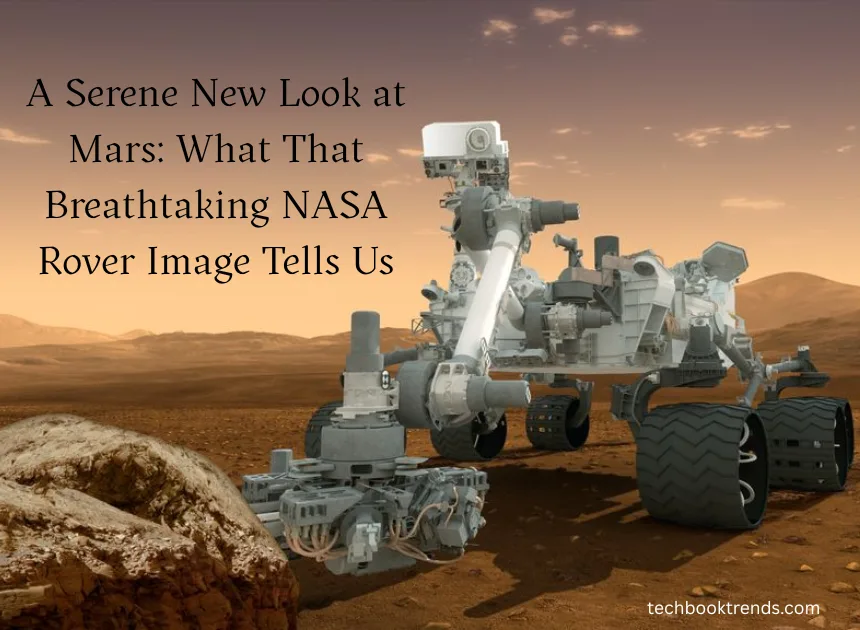
A Serene New Look at Mars: What That Breathtaking NASA Rover Image Tells Us
Every now and then, an image comes back from space that feels almost painterly — like someone captured a moment of quiet in a place you’d never expect calm. Recently, NASA’s Mars rover sent back one of those images. And if you scroll past it quickly, you might miss just how special it really is.
We’re used to thinking of Mars as a harsh, stark landscape — red rocks, dust storms, barren plains. But this photo doesn’t look like a battleground. It feels… serene. Almost contemplative.
And that’s worth talking about.
A Glimpse of Mars You Don’t See Every Day
Look at photos from Mars long enough and patterns start to form: wheels of rovers deep in red soil, jagged rocks, dust in the sky like a brown haze. They’re fascinating, but always rugged. Always alien.
This new image — whatever you call it — looks almost peaceful.
Soft lighting. Gentle shadows. A horizon that doesn’t feel like an edge of despair, but more like a quiet promise.
That contrast is striking. It catches your eye not because it shows something new about Mars’s geology, but because it feels different. It feels almost like the Mars we imagine during quiet moments of thought.
Why the Image Feels So Calm
There are a few technical reasons why this particular shot hits differently:
1. The Lighting Was Just Right
Mars has a thin atmosphere that scatters light differently than Earth’s. When conditions are right — low dust, proper sun angle — the light hits rocks and terrain in a way that feels unexpectedly soft.
On Earth, we take gentle light for granted at sunrise or sunset. On Mars, it’s rare.
2. Minimal Atmospheric Interference
Dust in the Martian sky often gives images a reddish or brownish tint. This one, however, feels clearer. That clarity allows more subtle tones to come through — a hint of blue in the sky, softer shading on rock edges, details that don’t feel exaggerated by color distortion.
3. Composition Happens Without Trying
The rover’s cameras aren’t trying to frame a “perfect photo.” They capture data. But in this case, all the elements came together — terrain, sky, shadows — in a way that feels composed.
Humans are wired to find patterns and emotion in imagery. Even if a robot took the photo without intent, our brains fill in meaning.
More Than a Pretty Picture
Of course, NASA didn’t send a rover to Mars just for beautiful postcards. Every photo has scientific value.
This serene image still helps scientists:
-
Understand the texture and composition of surface materials
-
Study how light behaves in Mars’s thin atmosphere
-
Track weather patterns and dust levels over time
-
Plan future rover navigation and sampling
A calm landscape might hide subtle clues about erosion, wind history, or ancient water activity. Sometimes the quietest scenes are the most informative, because they give a baseline — a snapshot of Mars in a relatively stable moment.
Connecting Emotion to Exploration
This is something that often surprises people: we project feelings onto space images. And that’s okay. It’s part of being human.
When you see a photo of Mars that feels peaceful, it’s not just about aesthetics. It’s about connection.
We’ve looked up at the stars for thousands of years, wondering if there’s a place out there that feels familiar. These modern rover photos don’t give us living beings or forests or oceans. But sometimes they show us something subtler — moments that feel meaningful, even if they’re just rocks and sky.
That emotional bridge — between science and feeling — is part of why space exploration matters to so many people.
A Reminder: Mars Has Seasons Too
Another reason this photo feels different is because Mars does, in fact, have seasons — like Earth. Dust levels, sunlight angles, and atmospheric clarity all shift over time.
What we’re seeing here might be a moment when dust is minimal, the sun is just rising or setting at the right angle, and the sky takes on a softer look.
It’s a reminder that Mars isn’t static. It changes. It breathes, slowly. And sometimes, it reveals a side of itself we don’t expect.
Why Images Like This Matter
There are hundreds of rover shots sent back every month. Most of them go unnoticed by the general public. But the ones that don’t — the ones that feel different — they matter for a few reasons:
-
They reignite public interest in space exploration
-
They remind us that exploration isn’t just technical — it’s emotional
-
They make space feel a bit more accessible
-
They make us feel a connection to a world 140 million miles away
This isn’t trivial. It’s a piece of the reason people fund space agencies, support science education, and dream about humanity’s future beyond Earth.
What Comes Next
Rovers keep sending photos back every sol (that’s what a Martian day is called). Some will be rocky, dusty, harsh — and that’s expected. But every so often, the stars (or the orbit, or the weather, or timing) align and we get a picture that stands out.
This might be one of those.
And when it does, it’s worth pausing. Worth thinking about what it means. Not just for science — but for us.
Because in a universe of noise and chaos, even a quiet, serene image from another world can feel… like a gentle reminder that we’re part of something bigger.
Also Read:



One thought on “A Serene New Look at Mars: What That Breathtaking NASA Rover Image Tells Us”